
Every year, Labour Day weekend · Montréal
Montréal Open
Blitz Bishops Edition
Three days, at least five classical rounds, side events, and a city that has been playing chess since 1844.
1844
Canada's first club
5+
classical rounds
3
days, Labour Day weekend
6 to 86
years old at the boards
The history
A city that has been playing for a very long time
Organized chess in Canada starts in Montréal. In 1844, the city founded the country's first chess club. The Thomas Workman trophy, awarded to the club champion, was donated as early as 1890. This is not a city that discovered the game recently.
Playing an open in Montréal on Labour Day weekend is a habit decades old. In the 1970s, at the height of the Fischer boom, there were enough players in town to fill two competing tournaments on the same weekend. The name "Montréal Open" has been carried by more than one organizer over time.
Blitz Bishops picked up the torch in 2025 at Casa d'Italia, then in 2026 at Collège Stanislas. This page tells that story: the city, the game, and what we are trying to build with it.
The timeline
Montréal and chess
A few verifiable markers, from the beginnings of organized chess in Canada to the most recent edition.
1844
The country's first club
Organized chess in Canada begins in Montréal with the founding of the Montreal Chess Club, the first chess club in the country.
1890
The Workman trophy
The Thomas Workman trophy is donated to the club champion.
1920s
An open takes root
Writing in 2011, ChessBase describes a Montréal Open then in its 91st edition, which places its beginnings in the 1920s.
1965
The Quebec Open begins in NDG
FQE archives start the Quebec Open in 1965, at the Notre-Dame-de-Grâce Centre in Montréal: 48 players on an October weekend. Gabor Lantos and Laszlo Witt share the win.
1970s
Labour Day becomes a habit
In September 1970, a Labour Day open is held at the NDG Centre. In September 1972, the same weekend hosts two competing tournaments: the Alekhine Open with 153 players and the Labour Day Open with 104.
1972
744 players
The year of the Fischer-Spassky match, the Quebec Open draws 744 players to École Père-Marquette in Montréal. It is the largest field in its archives from 1965 to 2000.
1977
Summer, and a 17-year-old
The Open moves to the summer and to the Cégep du Vieux-Montréal, its home almost every year until 2000. That first summer, 17-year-old American Yasser Seirawan finishes tied for first.
1979
The Tournament of Stars
From April 10 to May 7, Montréal hosts ten elite grandmasters, world champion Anatoly Karpov among them, in a category XV tournament. Karpov and Mikhail Tal finish tied for first after an 18-round double round robin.
1980s
Hundreds of players every summer
415 players in 1980, 532 in 1982. Legends come through too: in 1980 the American grandmaster Samuel Reshevsky finishes half a point behind the winner, Igor Ivanov.
1990s
The world comes to play
Boris Gulko wins in 1992. Grandmasters arrive from Russia, Poland, Lithuania, Cuba and Israel, and in 1998 the Yugoslav legend Svetozar Gligoric. Then a Quebecer takes over: Alexandre Lesiège wins in 1997 and 1998, and shares first in 2000.
2011
Collège Jean-de-Brébeuf
Two hundred and thirteen players across four sections, in a former chapel turned playing hall. Bator Sambuev and Hugues Masse share first place on 4.5 out of 5.
2025
Casa d'Italia
The first edition under the Blitz Bishops banner. A full week of rapid, classical and blitz, with thousands of dollars paid out in prizes.
2026
Collège Stanislas
Six sections, five classical rounds in Outremont, a Monday night blitz, and the first large tournament run end to end on ChessPass.
One honest note: this timeline brings together several distinct tournaments, including the Quebec Open, the Labour Day opens and the Tournament of Stars, run by other organizers across the decades. They tell the story of the city. This page documents the Blitz Bishops edition of the Montréal Open, without claiming descent from the others.
The tournament today
What it is, every year
An annual fixture on Labour Day weekend. At least five classical rounds, sections by strength, and side events for anyone who never gets enough chess.
- When
- Every year on Labour Day weekend, Saturday through Monday
- Main format
- Swiss system, at least five classical rounds
- Sections
- By rating band, from the Open section down to the youngest players
- Rated
- FQE, CFC and FIDE
- Where
- Montréal. The hall changes from edition to edition.
- Registration
- Online, through ChessPass
The side events
The classical is the heart of the weekend, but it does not stand alone.
Blitz
An evening blitz tournament, separate from the classical, open to everyone
Rapid
When the calendar allows, as in 2025
Skittles room
Free tables to replay the game, between rounds
Booths and coffee
Partners, equipment, and enough fuel to reach the evening round
Team prizes
Teams of 2 to 4 players, drawn from any section
The experience
Not just a tournament. A weekend.
You, your opponent, 64 squares and the clock. The purest form of competition there is.
Sponsors
Your brand, in front of an entire community
200+ players and their families, for three full days. At the venue, online and on the mic. Four packages, each more visible than the last.
See the packagesArchive
Every edition, kept on the record
2025 at Casa d'Italia, 2026 at Collège Stanislas. The photos, the results and the story of each weekend.

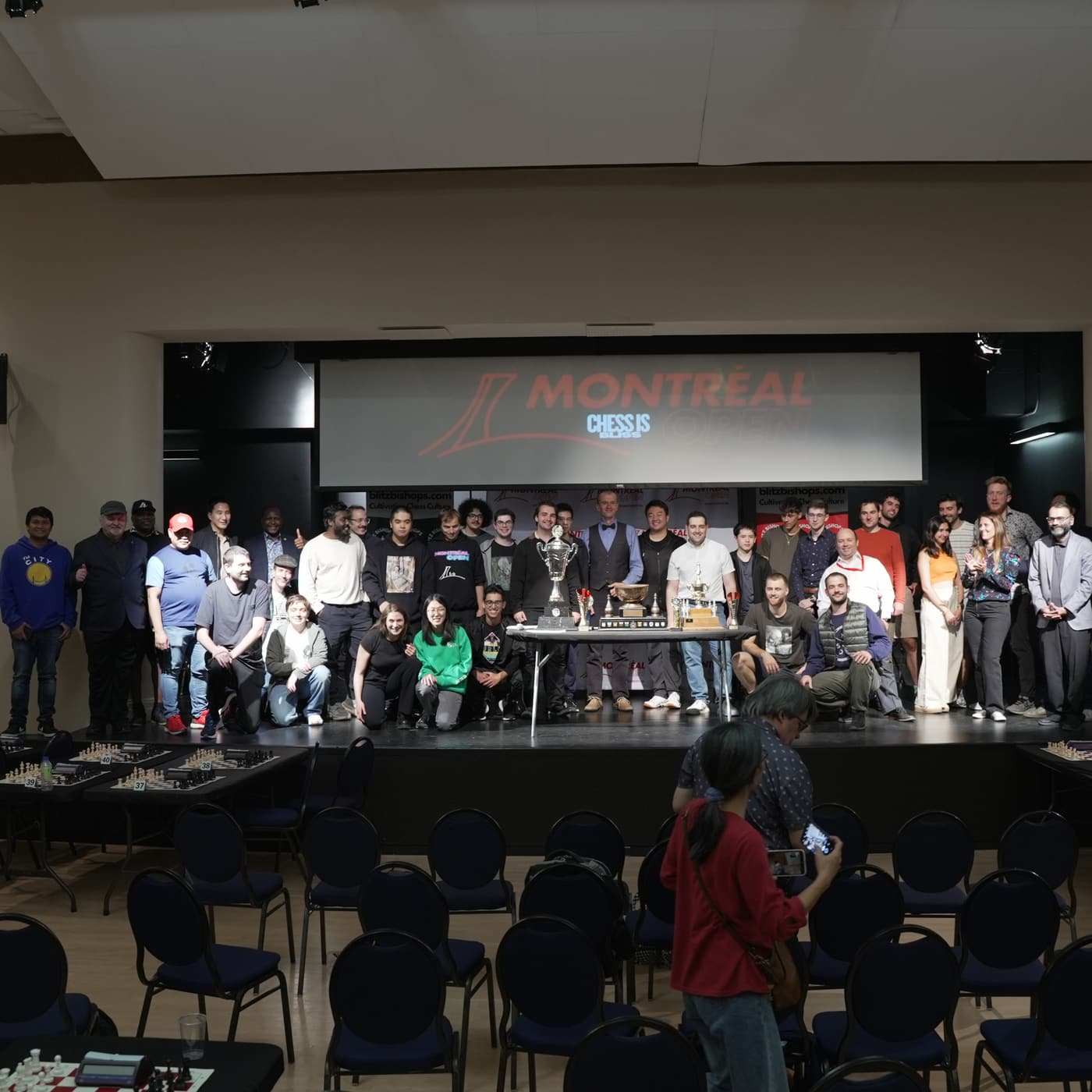
We go again next year.
Dates for the next edition are announced on ChessPass. Until then, we play at the café most nights of the week.